
Ancient Egypt
Why Ancient Egypt Still Fascinates the World
Three thousand years on, ancient Egypt still holds a grip on the global imagination that few civilizations ever earn. Here's why — and what of it you can actually walk through in person today.
Ancient history is having a moment. Museum blockbusters sell out months in advance, documentary series about lost cities rack up hundreds of millions of streams, and a new generation of archaeologists has turned excavation footage into some of the most-watched content on social media. Rome, the Maya, Mesopotamia, the Inca — all of it draws an audience now in a way it rarely did a generation ago, when ancient history sat quietly in the school-textbook category and stayed there.
Within that boom, one civilization keeps pulling numbers the others simply don't. A Tutankhamun exhibition can still sell out a major Western museum decades after the boy king's tomb was first opened. A single YouTube documentary about the pyramids can out-view a dozen well-produced films about equally old, equally sophisticated cultures. Ancient Egypt isn't just part of the current wave of interest in the past — it's disproportionate within it, and that disproportion is worth actually explaining rather than taking for granted.
A Civilization That Keeps Winning the Ratings
Look at where the attention actually concentrates. Video game franchises set in ancient Egypt regularly outsell entries set in ancient Rome or feudal Japan. Egyptian imagery shows up in advertising, fashion, and architecture (Las Vegas built an entire casino shaped like a pyramid, complete with a sphinx out front) in a way no other ancient culture's visual language does. Even people who couldn't name a single pharaoh beyond Tutankhamun can usually sketch a rough outline of a pyramid, describe a sarcophagus, or explain — badly, but confidently — what a mummy is. That's not a small cultural footprint. That's a civilization that colonized the general public's imagination and never really left.
What Actually Makes Ancient Egypt Different
Some of this comes down to something refreshingly simple: nothing else ancient is both this large and this intact. The Great Pyramid of Giza has stood for roughly 4,500 years, and it's still recognizably, unmistakably itself — not a ruined foundation, not a reconstruction, not a scale model behind glass. Compare that to most of the ancient world's other headline sites. The Colosseum survives as a dramatic shell of what it was. Mesopotamia's ziggurats were built largely from mudbrick and have eroded accordingly. Great swaths of Maya architecture spent centuries reclaimed by jungle before excavation began. Egypt's monuments, built in stone in one of the driest climates on Earth, simply survived better than almost anything else humans built before the modern era — and survival at that scale does something to how a place gets remembered.
The written record adds a second, less obvious layer. Hieroglyphics went unreadable for over a thousand years after the last person who could fluently read them died out — until the Rosetta Stone, discovered in 1799, gave scholars a bilingual key, and Jean-François Champollion finally cracked the script in 1822. Once that door opened, it opened onto an enormous archive: tomb inscriptions, temple walls, papyrus records, all preserved by the same dry desert climate that kept the buildings standing. Few ancient civilizations left this much of their own voice this intact. We don't just have Egypt's monuments — we have a startling amount of what the people who built them actually wrote down, prayed for, and believed.
And what they believed happens to be genuinely gripping as a story. Ancient Egyptian religion built an entire, richly detailed cosmology around death and what came after it — the heart weighed against a feather, a soul's journey through the underworld, gods with animal heads standing in judgment, an elaborate mummification process built specifically to prepare a body for eternity. None of that reads as dry theology. It reads as narrative, which is exactly why it has translated so cleanly into film, fiction, and museum storytelling for well over a century, long before anyone thought about ancient history as "content."
The Grand Egyptian Museum Reset the Clock
If ancient Egypt's grip on the world ever loosened, it's tightened again recently, and there's a specific reason why. The Grand Egyptian Museum, built near Giza specifically to house Egypt's antiquities at a scale no previous museum ever could, is now fully open — and for the first time in history, Tutankhamun's entire collection, more than five thousand objects recovered from his tomb, is displayed together in one place rather than split across galleries or kept partly in storage. That alone was enough to put ancient Egypt back at the center of global travel and history coverage in a way it hadn't been in years, and it's part of why interest in seeing the country in person has climbed right alongside it.
What You Can Actually Walk Through Today
The genuinely remarkable part is how much of this isn't locked behind glass or confined to a screen. A trip to Egypt puts you inside the actual story, not a recreation of it.
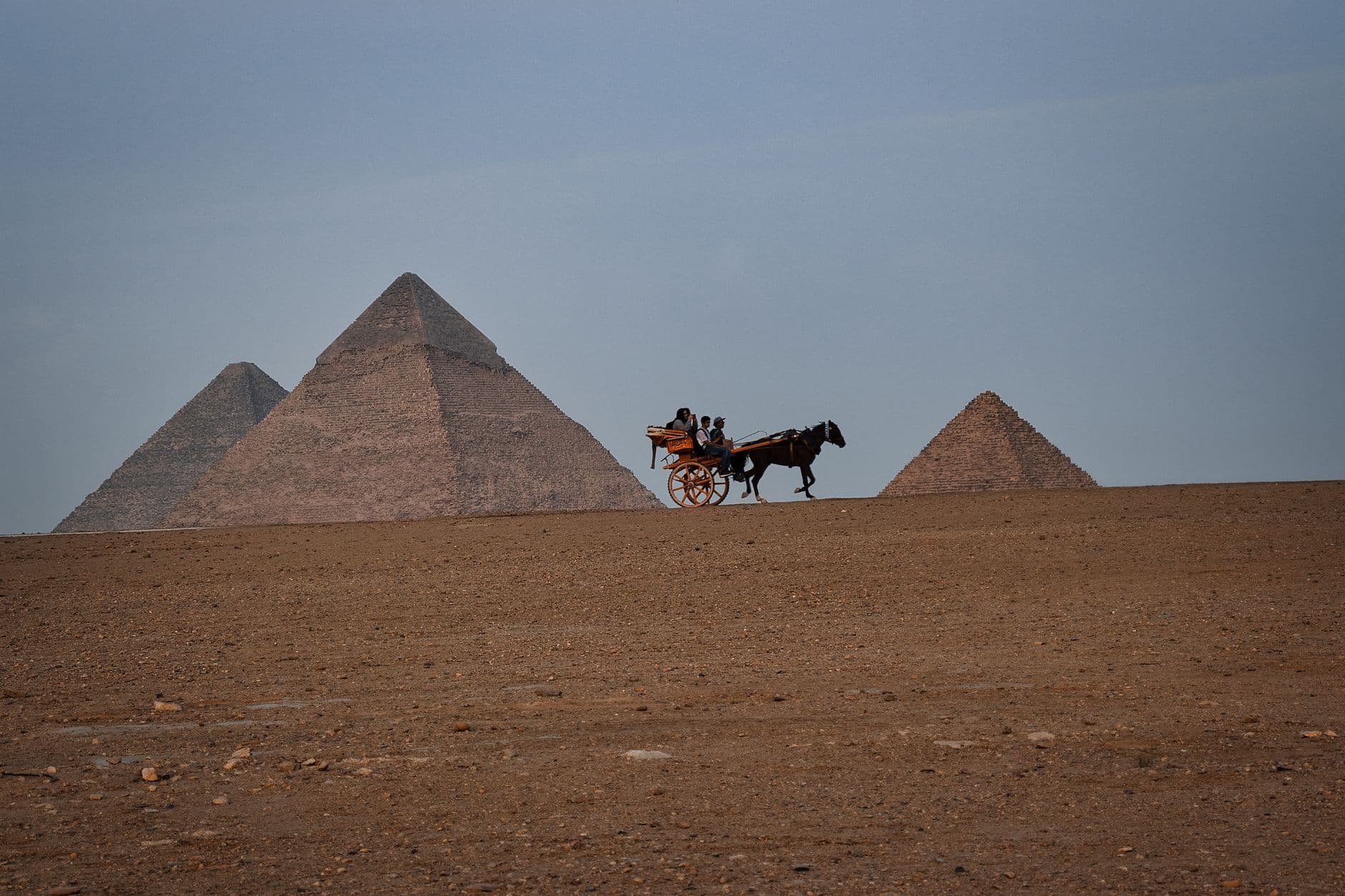
- Giza — the Great Pyramid, its two smaller companions, and the Sphinx, standing exactly where they were built, still the only one of the Seven Wonders of the Ancient World left standing
- The Grand Egyptian Museum — Tutankhamun's full collection under one roof, alongside colossal statuary and artifacts spanning the whole of ancient Egyptian history
- Luxor's Valley of the Kings — the rock-cut royal tombs, their painted interiors still holding color after three thousand years underground
- Karnak and Luxor Temple — the largest religious complex ever built, connected to a second great temple by a restored avenue of sphinxes
- Abu Simbel — Ramesses II's colossal rock temples in the far south, angled so precisely that twice a year the sunrise lights the inner sanctuary
- A Nile cruise between Luxor and Aswan — the river route that ties the major sites together the same way it tied ancient Egypt itself together
Standing at the Base of the Pyramid
Photographs never quite prepare people for the scale of Giza in person. The Great Pyramid was the tallest structure on Earth for roughly 3,800 years, and standing at its base — close enough to see the individual limestone blocks, some weighing several tons apiece, stacked with a precision that still isn't fully explained — makes the abstract history suddenly, physically real. It's one thing to read that ancient Egyptians built something enormous. It's another to stand next to it and understand, in your body, what "enormous" actually meant to the people who built it, and still means for anyone who visits today.
The Grand Egyptian Museum delivers a quieter version of that same jolt. Tutankhamun's gold mask is the object everyone comes for, but it's the sheer volume around it that changes how the visit actually feels — room after room of furniture, chariots, jewelry, and everyday objects, all pulled from a single tomb belonging to a minor king who died young. Multiply that by the scale of what a major pharaoh's tomb must once have held, almost none of which survived robbery and time, and the museum does something textbooks never quite managed: it makes the loss of the rest of the ancient world's treasures feel as real as what's actually still in front of you.
That's the real reason ancient Egypt keeps out-fascinating civilizations just as old and just as sophisticated: almost none of them left this much still standing, this well documented, and this genuinely visitable in one country, on one trip. We build our Giza and Grand Egyptian Museum touring around exactly that — getting people close enough, early enough in the day, to actually feel the scale rather than just photograph it from a bus window.
Frequently Asked Questions
A combination of factors rarely found together elsewhere: monuments that are both enormous and remarkably intact after thousands of years, an unusually complete written record preserved by the desert climate, and a mythology and afterlife tradition that reads as genuinely vivid, narrative material rather than abstract theology.
Roughly 4,500 years old, generally dated to around 2560 BCE during the reign of Pharaoh Khufu. It's the last of the ancient world's Seven Wonders still standing.
Yes, the Grand Egyptian Museum near Giza is fully open, including the complete Tutankhamun collection displayed together for the first time — a major reason interest in visiting Egypt has climbed recently.
The breakthrough came from the Rosetta Stone, discovered in 1799, which carried the same text in three scripts, including Greek. Scholar Jean-François Champollion used it to decipher hieroglyphics in 1822, after they'd been unreadable for over a thousand years.
A full but comfortable overview — Giza, the Grand Egyptian Museum, Luxor's temples and the Valley of the Kings, and a stretch of the Nile — generally takes 6 to 8 days. A single focused day covers Giza alone; a longer multi-day trip is what actually connects the sites the way ancient Egypt itself was connected.
None of this fascination is really about nostalgia for a school textbook. It's that ancient Egypt built something so large, so well preserved, and so thoroughly documented that it still holds up against direct, physical scrutiny thousands of years later — and that's a genuinely rare thing for any civilization to have pulled off. The pull that started with a picture of a pyramid in a childhood book is still there for a reason. It's just waiting for you to actually go stand in front of it.
See It in Person
Giza, the Grand Egyptian Museum, and beyond — build a trip around the history that's fascinated you since you were a kid.
Explore Giza & the Grand Egyptian MuseumWhere This Takes You
1 Day Giza Tour: Exploring Ancient Wonders
Pyramids, Sphinx, and a free private photoshoot — all in one day.
Aswan & Abu Simbel: Nubia's Ancient Temples
Philae Temple, the High Dam, and the colossal statues of Abu Simbel.
8 Days Essential Egypt + 5-Day Nile Cruise
Cairo and Giza, then five days cruising the Nile in 5-star comfort.
Continue Exploring
Ancient Egypt
How Were the Great Pyramids Actually Built?
The Great Pyramid of Giza has stood for over 4,500 years. Here's what archaeologists actually know — and don't know — about how it was built.
Travel Guides
The Grand Egyptian Museum: What to Know Before You Go
The Grand Egyptian Museum is now fully open, with Tutankhamun's complete collection displayed together for the first time. Here's what a visit actually involves.
Ancient Egypt
Why People Around the World Dream of Seeing Ancient Egypt
For most people, ancient Egypt is the first civilization they ever learned by name. Here's why it holds that place — and how that childhood fascination turns into an actual trip.