
Behind the Scenes
The Egypt You Don't See on Instagram
Behind the pyramid selfies and staged sunsets is a country that goes on living, cooking, arguing, and trading exactly as it has for centuries. Here's the Egypt that never makes it into a travel feed.
There's a growing fatigue with the curated version of travel — the same ten angles of the same ten landmarks, the same golden-hour filter, the same caption about wanderlust. More travelers are saying out loud what a lot of people have quietly felt for a while: that an algorithm-optimized itinerary, built entirely around what photographs well, can leave you standing in a place without actually experiencing it. The backlash isn't against photography itself, it's against letting the photo decide the whole trip.
That fatigue has produced a real shift in what people are looking for — less "where's the shot" and more "where's the actual place." Travelers are asking for unfiltered neighborhoods, working markets, food stalls with no menu in English, anything that reads as lived-in rather than staged for visitors. Egypt is an unusually good answer to that search, because so much of what makes the country interesting was never built for a camera in the first place. It just happens to still be there, going about its business, whether anyone photographs it or not.
Behind the Tourist Strip
Cairo's tourist areas are real, but they're a thin layer over something much larger. A few streets back from the hotels and souvenir shops near any major site, the city stops performing for visitors and just continues being itself — apartment blocks with laundry strung between balconies, corner grocers who know every regular by name, mechanics working on cars half in the street because there's nowhere else to put them. It's not dramatic in the way a monument is dramatic. It's just Cairo, doing what a city of over twenty million people does every single day, largely indifferent to whoever happens to be walking through with a camera.
Tea, Backgammon, and the Rhythm of a Cairo Evening
Come evening, the ahwas — small, plastic-chaired coffeehouses that spill onto the sidewalk — fill with men playing backgammon over glasses of sweet tea or thick, sediment-heavy Turkish-style coffee, the click of the dice and the slap of pieces on the board carrying down the street. It's one of the oldest, steadiest rhythms in the city, unhurried in a way that runs directly against the pace of a typical sightseeing day. Nobody's performing authenticity here; this is just what a Cairo evening actually sounds like, and has for generations.
A Real Market Versus a Tourist Market
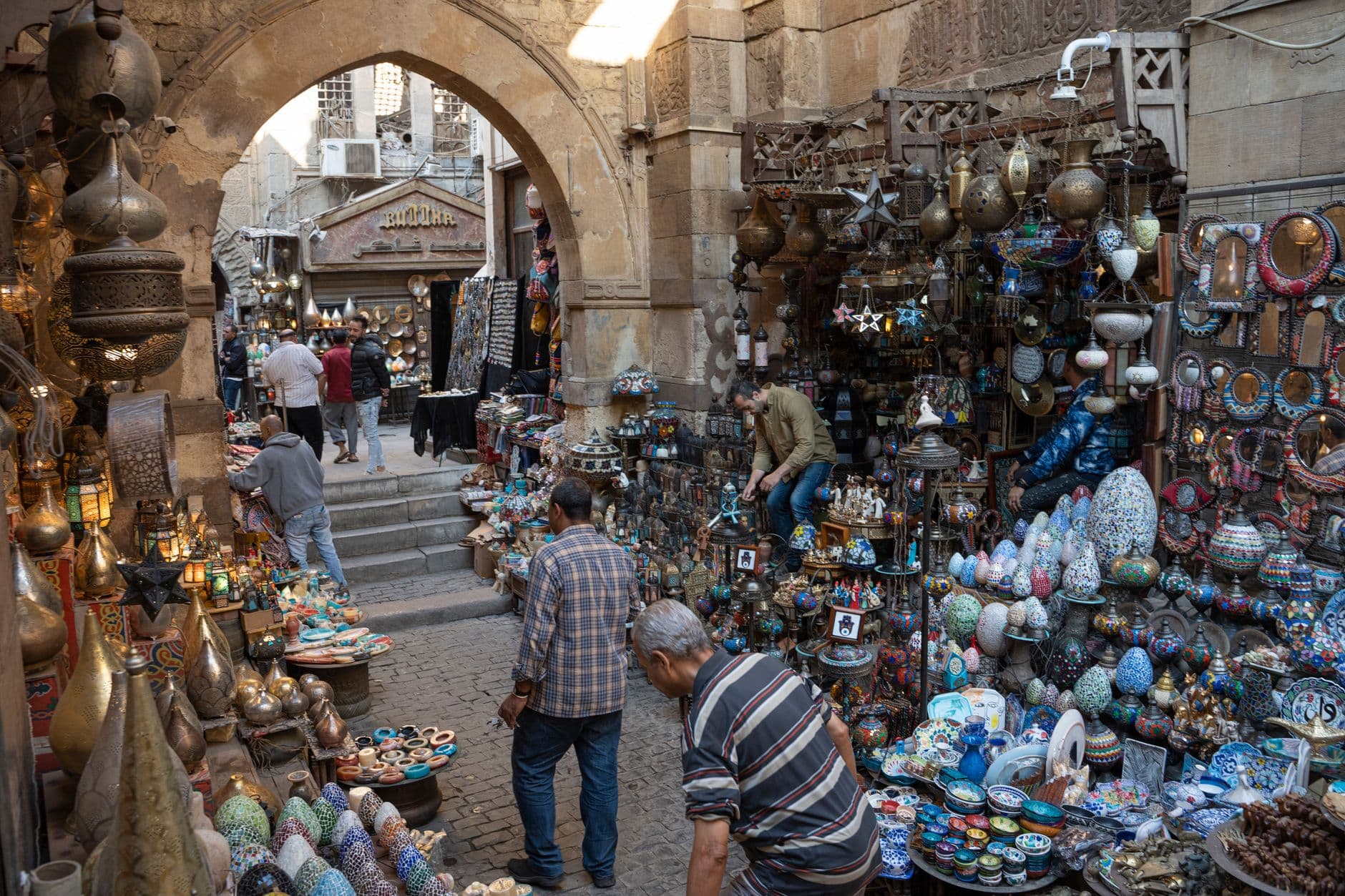
There's a real difference between a market built for visitors and a market Egyptians actually shop at, and it shows up almost immediately in how the negotiation works. In a tourist-facing stall, the opening price is a starting position in a script both sides already know. In a real neighborhood market, the haggling is faster, sharper, and less theatrical — it's simply how price is set for everything from vegetables to fabric, a genuine back-and-forth rather than a performance for an audience. Watching it, or better, taking part in it, tells you more about how Egyptians actually transact with each other than any museum placard could.
Khan el-Khalili's Back Lanes
Most visitors experience Khan el-Khalili as its main lane — the wide central strip lined with souvenir stalls selling the same papyrus prints and alabaster statues, priced for tourists and largely interchangeable from one shop to the next. That's not wrong, exactly, but it's a fraction of the district. Turn off that main lane into the narrower alleys running behind it and the market changes character almost immediately: workshops where craftsmen actually make the metalwork and woodwork rather than just sell it, spice merchants selling to Cairene households rather than to visitors, and small stalls that have supplied the same few blocks with bread, cheese, or cooked food for decades. These lanes were never designed to be photogenic. They were designed to function, and they still do.
Family-Run Food Stalls That Never Make the Guides
Some of the best food in Cairo comes from stalls with no sign, no menu, and no online presence at all — a family recipe for koshari, ful, or grilled meat sold from the same cart or storefront that's been in the same spot for longer than most guidebooks have existed. These places don't need marketing because they've never needed tourists; the neighborhood alone has kept them running for years. Finding them without local knowledge is close to impossible, which is exactly why they've stayed exactly what they are.
The Call to Prayer as Everyday Soundscape
For a visitor, the call to prayer can register as a striking, almost cinematic moment — a reason to stop and record something. For Cairo itself, it's simply the sound the day is organized around, five times over, woven into the background of ordinary life the way traffic noise or birdsong is elsewhere. Shops pause briefly, some people step into a nearby mosque, most simply continue whatever they were doing. It's worth noticing not as a photo opportunity but as a genuine marker of how differently a place can experience the same sound a visitor only hears once and remembers as remarkable.
Coptic and Islamic Cairo, Side by Side
Old Cairo holds a religious history that's easy to walk past without registering its scale — Islamic Cairo's mosques and madrasas stacked block after block, and, a short distance away, Coptic Cairo's ancient churches, some of them among the oldest in continuous use anywhere in the Christian world. The two neighborhoods sit close enough to visit in the same day, and seeing them together says more about Egypt's layered religious history than either does alone. Neither is staged for visitors; both are still functioning places of worship, quieter and less crowded than Khan el-Khalili just a short walk away, and easy to miss entirely if a trip is built purely around headline sites.
What Gets Lost When a Trip Is Only Built for the Feed
There's a real cost to planning a trip entirely around what will photograph well, and it isn't just missing out on a few interesting side streets. It's the difference between passing through a place and actually being in it. A visitor who moves from photo stop to photo stop, checking off the same handful of angles everyone else already has, tends to leave with a fuller camera roll than understanding — a country reduced to its ten most photogenic seconds rather than experienced as the layered, working place it actually is. Egypt in particular rewards slowing down, because so much of what makes it interesting sits just slightly off the obvious path: a conversation with a shopkeeper who's run the same stall for thirty years, a tea break that runs twenty minutes longer than planned, a wrong turn down an alley that turns out to be the best part of the afternoon.
How Locals Actually Move Through Their Own City
Watch how Cairenes actually navigate their own city and it looks nothing like a tourist's route through it. Locals cut through side streets a map app wouldn't suggest, know exactly which bakery has bread coming out of the oven at what hour, and treat the call to prayer as a timekeeping device as much as a spiritual one — a way of knowing roughly what time it is without checking a phone. None of this is hidden or secretive. It's simply the ordinary texture of daily life in a city that's been continuously inhabited for well over a thousand years, and it's available to anyone willing to walk a few streets past where the tour buses stop.
Look Past the Main Lane
The most interesting version of Khan el-Khalili is rarely the version photographed from its main lane. Ask a local guide to take you into the side alleys behind the tourist stalls, where the workshops and family-run food stands actually are.
Frequently Asked Questions
The main lane is genuinely touristy, but the market extends well beyond it. The back alleys still function as a real neighborhood market and workshop district, and they're a short walk from the souvenir strip most visitors never leave.
A local guide is the fastest way in. Someone who lives there can walk you past the main tourist strip into the working streets, family-run food stalls, and back lanes that don't show up in a standard guidebook.
Islamic Cairo is the historic district built up around Cairo's mosques, madrasas, and Islamic architecture over roughly a thousand years. Coptic Cairo is a separate, older quarter holding some of the world's oldest surviving Christian churches. Both sit in Old Cairo and are usually visited together.
Use the same judgment you'd use anywhere — ask before photographing people directly, and be mindful that a lived-in neighborhood isn't a stage. Streets, storefronts, and markets are generally fine; people's homes and faces deserve permission first.
Even a single guided food walk or Old Cairo walking tour gets you well past the surface level most short trips settle for. It's less about how many days you have and more about deliberately choosing a route that goes off the main tourist strip.
The pyramid photo and the sunset felucca shot are real, and worth having. But they're a small slice of a much bigger, much older country that keeps living exactly as it has, mostly indifferent to whoever's visiting that week. Spend even one afternoon in Cairo's back lanes rather than only its front ones, and the trip stops feeling like a stop on someone else's feed and starts feeling like your own.
Meet the Real Cairo
A local guide takes you past the souvenir stalls into the Cairo that's actually still lived in.
Join the Khan El-Khalili Food WalkWhere This Takes You
Islamic Cairo & Coptic Cairo Walking Tour
Al-Azhar Mosque, the Hanging Church, and the old city on foot.
Continue Exploring
Behind the Scenes
Egypt Through Local Eyes: What Khan El-Khalili Really Is
The first in an ongoing series looking at Egypt through a local lens: what Khan el-Khalili actually is once you get past the souvenir stalls lining its main lane.
Travel Guides
Islamic and Coptic Cairo: A Walking Guide to Old Cairo
Beyond the Pyramids, Cairo holds a thousand years of Islamic architecture and some of Christianity's oldest surviving churches — both walkable, both often skipped.
Culture
What Does Egypt Taste Like? A Foodie's Guide to Egypt
Food increasingly decides where people travel. Here's what Egypt actually tastes like — koshari carts, ful at dawn, sugar-heavy tea — and where to eat it the way Cairenes do.